Data Centers and Colocation for Growth: How to Build Infrastructure That Scales
Authored by
Saasence Editorial Team
Date Released
March 2, 2026
Infrastructure is no longer “just IT”—it’s the foundation of uptime, customer trust, and operational speed. This guide explains what data center and colocation services are, when they make sense, how to evaluate cost and compliance, and how to design a hybrid infrastructure strategy that supports long-term growth.
Key Takeaways
- Colocation is often the best middle ground between on-prem and cloud for performance, control, and predictability.
- The right infrastructure choice depends on latency needs, compliance, and integration with cloud services.
- Evaluate total cost of ownership (TCO) beyond rack fees—power, bandwidth, cross-connects, and support matter.
- Security and compliance should be validated through operational controls and audit posture—not marketing claims.
- Hybrid architecture (colo + cloud) is a practical default for many growth-stage and regulated organizations.
The Real Reason Infrastructure Strategy Matters
When customers expect “always on” services, infrastructure becomes a revenue and reputation lever. The organizations that scale reliably focus on three priorities:
- Service availability through redundancy and disaster recovery readiness
- Strong data protection with physical security and governance controls
- Predictable cost through smart capacity planning
This is why many teams move away from aging server rooms toward professional data center and colocation facilities—especially as AI workloads, analytics platforms, and high-availability applications become standard.
Saasence Insight: Infrastructure failures rarely begin with major outages. They usually start with small blind spots—power constraints, weak change control, poor observability, or shared environment risks.
Colocation vs Cloud vs On-Prem: A Decision Framework
Choose Cloud when you need:
- Rapid provisioning and elastic scaling
- Managed services such as databases, queues, and ML platforms
- Global reach without managing hardware
- Fast iteration for product and engineering teams
Choose Colocation when you need:
- Predictable performance and lower latency
- Control over specialized hardware or high-density compute
- Data residency or regulatory requirements
- Better long-term cost predictability at scale
Choose On-Prem when:
- Hard constraints require fully owned facilities
- You can justify capital expenditure and operational overhead
- You require specialized physical infrastructure control
What to Evaluate: Cost, Security, Connectivity, Risk
1) Cost (TCO, Not Just Rack Fees)
Common cost components include:
- Rack, cage, or private suite fees
- Power costs per kW and power density limits
- Bandwidth and network charges
- Cross-connect fees
- Remote hands or managed services
- Migration and operational overhead
A strong infrastructure decision compares colocation against cloud and on-prem options using full total cost of ownership models—especially when workloads run continuously.
2) Security and Compliance Readiness
Security validation should include:
- Physical security controls and restricted access zones
- Identity governance and role-based access policies
- Operational logging, monitoring, and audit readiness
For regulated industries, ensure alignment with frameworks relevant to your environment, such as SOC 2, ISO 27001, PCI DSS, HIPAA, or GDPR depending on scope.
3) Connectivity (Carrier and Cloud Proximity)
Connectivity affects both performance and cost:
- Carrier diversity for resilience
- Direct connectivity to cloud providers
- Network architecture designed for future growth
Use Cases That Benefit Most from Colocation
Colocation tends to deliver the most value when performance, control, or governance matters.
- Financial systems requiring low latency and stable connectivity
- Healthcare and regulated data environments
- eCommerce or SaaS platforms that require high uptime
- AI and analytics workloads with high power density needs
- Global businesses needing regional infrastructure presence
Hybrid-by-Design: Combining Colocation and Cloud
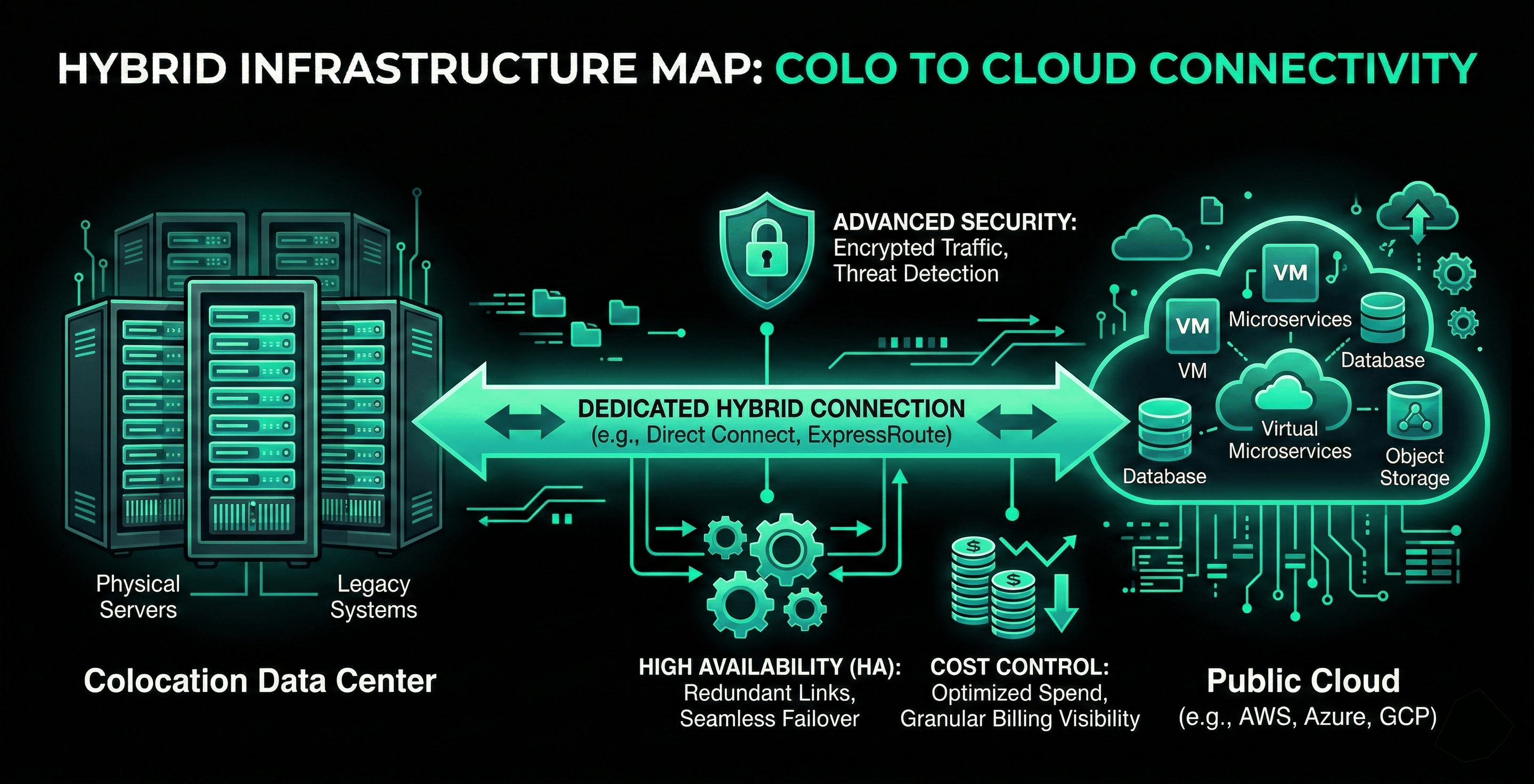
Most modern infrastructure strategies use a hybrid model where colocated systems handle stable workloads while cloud platforms provide elasticity and managed services.
A practical hybrid model includes:
- A colocation footprint for core systems or data-intensive workloads
- Direct cloud connectivity for lower latency and reduced egress costs
- Unified monitoring and security governance
- Disaster recovery planning across multiple regions
Mini Scenario: A Realistic Hybrid Strategy
A B2B SaaS company runs stable databases and compliance-sensitive workloads in colocation while using cloud infrastructure for web scaling, analytics, and CI/CD pipelines. During traffic spikes, cloud services absorb demand while colocated systems maintain predictable cost and performance.
Checklist: Choosing a Provider Without Regret
- Confirm business goals such as latency, uptime, and compliance
- Define workload requirements for storage, network, and compute
- Validate redundancy in power, cooling, and connectivity
- Review physical security policies and access procedures
- Confirm compliance alignment based on industry requirements
- Evaluate connectivity options and carrier diversity
- Compare total cost across 12–36 months
- Plan migration and rollback strategies
- Define operational responsibilities and escalation paths
What Most Teams Miss
- Underestimating power and cooling requirements for modern workloads
- Treating compliance as a checkbox instead of an operational process
- Ignoring connectivity economics like cross-connects and cloud egress
- Failing to plan for regional or international expansion
How Saasence Helps
Saasence helps organizations design infrastructure strategies that balance reliability, security, and cost efficiency. We support evaluation, architecture planning, colocation and cloud integration, migration execution, and governance setup— enabling businesses to scale confidently while maintaining operational control.
Conclusion
Data center and colocation services remain a powerful foundation for scalable infrastructure— especially when paired with cloud platforms in a hybrid model. The winning approach combines clear requirements, strong connectivity planning, disciplined cost modeling, and governance from day one.
Ready to Get Started?
If you’re evaluating data center or colocation options—or planning a hybrid infrastructure strategy—Saasence can help you make the right decision with clarity. We start with a quick discovery to map workloads, performance constraints, compliance needs, and growth plans, then deliver a structured recommendation and implementation roadmap.